Marshall Plan
Taking over hollowed out institutions is usually part of a plan but is rarely good, especially when some damn fool thinks he's got god on his side.

A little slow this one as I’m restricted to one hand and will be for a week or three.1

Empty Vessels
The takeover has been part of business for as long as anyone can remember. Selling out to another firm provides a convenient way for owners who have grown a business to realise their investment, retire or restart. It provides the new owners to establish themselves in an existing market with the hard work of market building and brand recognition already done and to grow their footprint and possibly eliminating a competitor along the way. They can be friendly, win win arrangements, of necessity rescue packages for firms and owners running out road (or cash), or they can be hostile, where publicly quoted companies are consumed by corporate predators. To the brand follower it usually matters little who owns the product.
In the political world, where despite changes that have weakened traditional voter allegiance, brand loyalty still means something, the hostile takeover seems in the early 21st century to have become the preferred modus operandi of ideological factions. Ideological infiltration leading to takeover has always been a thing on the fringes where the dark angels of left and right danced on the heads of pins for largely irrelevant control of pointless parties but it was once the case that the big parties were too difficult. Attempts to ‘enter’ UK Labour before the mid-1980s though only a few thousand activists, drilled a long way into the organisation’s local structures enabling a significant policy presence at party conferences. Going further, however, was beyond the capabilities of the fringe – too many power centres, too many different affiliated bodies and too many real people supporting Labour’s core project to displace. In the same period the UK Conservatives were in much of the land a true ‘mass party’ with members weaved through the fabric of society.
No longer the case. In the 2010s both parties of UK government became hollowed out whilst at the same time becoming membership democracies. Not a good combination. The Conservatives became UKIP Lite, with a migrated membership hostile to its long standing view of the national interest while Labour oscillated between European social democracy, old fashioned Labourism, and statist anti-capitalism with influx and outflow of multiple leftist brands. Some of the grouplets that found homes in Labour between 2010 and 2020 have now migrated to the Green Party, which has apparently chained its environmental scooter against the lamp post of socialist rhetoric. For now.
But as ever UK party politics is a pale shadow of the USA. The factionalism of the Democrats was a central factor in their failure to consolidate their apparent advantages, meanwhile the Republicans, so long the party of Main Street USA, became a vehicle of the new right, first through ‘Tea Party’ and latterly MAGA takeovers. The ‘broad churches’ of the US centre have become the increasingly polarised some of ideological caucuses and it isn’t ending well. In the lurching rightward of the GOP the influence of the ‘evangelical’ churches, alongside FOX News, has helped underpin the Christian Nationalism of MAGA.
With god on his side
Back in the UK another moribund institution with disproportionate influence is vulnerable to takeover and there is some evidence that it’s happening, what’s more funded and promoted by the same wealthy sponsor, the hedge fund owner, Paul Marshall, who has turned GB News into Reform TV. Long before the USA was even a twinkle, the Church, under Rome, was, the pre-capitalist ideological vehicle which essentially ran the one party state. One in ten of the population of medeival England worked for the church – good one party state stuff. The King and the King’s Men claimed their legitimacy from the Church and the Church exercised its power in tandem with the King. When the interests of the two clashed the Church of England’s creation and state establishment was the result, so the one party state continued through and beyond a couple of centuries of ripples. In the twentieth century the Church of England was referred to as ‘the Tory party at prayer’ and in suburban and rural England was indeed one of the useful channel for Conservative activists to do their thing as respectable members of the community. No longer. Both institutions are shells but the church still has buildings and an organisational structure that a determined, funded ideological grouping could populate. Disestablishment is long overdue. The evidence of Marshall’s antics is set out in this piece by James Bloodworth. Meanwhile we hear more and more references to the UK as a ‘Christian’ country and Judaeo/Christian culture from the Faragistas.
Marshall’s malign influence, which also includes Unherd and The Spectator, can be found in each of the serial disasters befalling British politics since 2005, including the emergence of the ‘Orange Book’ faction at the top of the Liberal Democrats and Nick Clegg’s capture of the leadership and thus the propping up of the catastrophic Cameron regime, shifting to back the ascendency of Michael Gove and the Leave campaign, followed by a descent into alt-right conspiracy and climate denialism, leading involvement in the anti-enlightenment Alliance for Responsible Citizenship (ARC), de facto alliance with the Faragistas and sponsoring a network of Anglican churches called Holy Trinity Brompton (see Bloodworth’s article). He is also a big noise in Ark (not ARC – not much) a ‘charity’ running schools at the states expense in the effectively privatised Goveist English education system from which he stood back after some dubious opining on Twitter. His son, Winston, was a member of the terminally dull folk rock band, Mumford and Sons, but left after some dubious opining on Twitter. So nothing good then.
Politicising religion is nothing new, the pre-capitalist church was one party ideology by other means, but in the modern world it has proved disastrous for more than one faith and quite a few states. We should by now be well warned of its consequences, but we are also almost uniquely vulnerable among European democracies to it’s misuse by charlatans. We need it like a hole in the head.
Seen and heard
It’s a while since I flagged up some worthwhile pieces to read/watch/listen to, so here goes.
In the US political swamp.
For a glimpse of a possible future beyond the Orange Nightmare listen to California Governor, Gavin Newsom, on The Rest is Politics Leading. Newsom has been one of the few to take the battle to Trump and understands that you can’t choose to battle the new fascism in a ‘fair fight’ when they are determined to lode the dice. Newsom is dyslexic (which the stupefyingly ignorant Trump regarded as “dumb”) and a fantastic communicator. Peter Kyle, MP for Hove and Business Secretary is also dyslexic and also his party’s best communicator. I know I’m biased on these things but I don’t think that’s an accident. Run Gavin run.
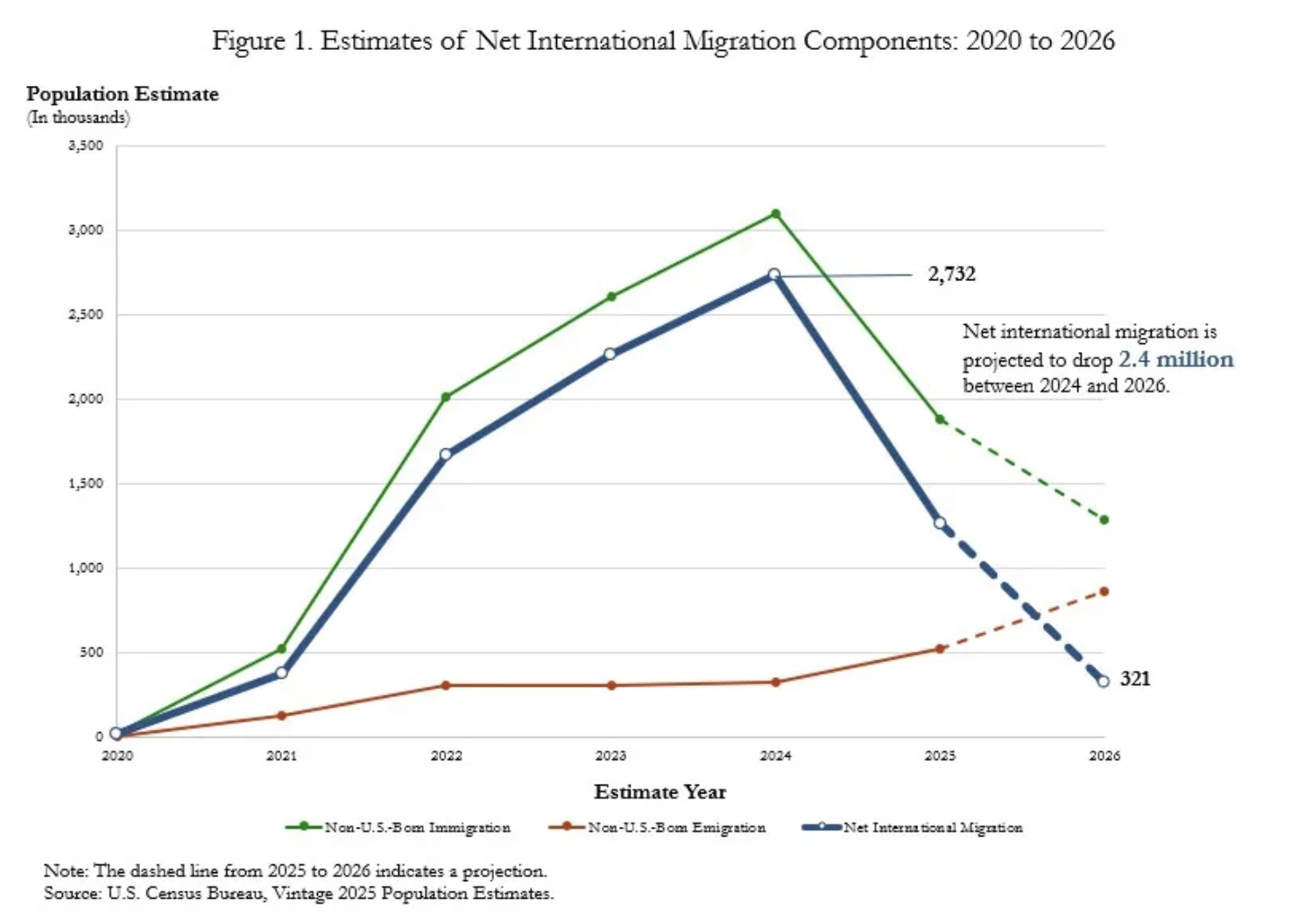
Trump may be ignorant, his approval ratings are down the pan, and his ICE stormtroopers are deeply unpopular but that doesn’t mean all his tactics are not having the intended effect. Paul Krugman explains how US immigration is heading net negative for the first time since the Vietnam draft.
Meanwhile in Texas the GOP are having a primary squabble for the ages between two awful alternatives. I’ve done a fair bit of negative campaigning in my time but this attack ad really takes the cake. Yee ha!2
It’s worth reminding ourselves that we are a mere 14 months into the second Trump term. It’s exhausting isn’t it. Oxford Prof Ben Ansell, whose Political Calculus Substack is always worth a read rounds up the madness of 2026 thus far and looks forward (a seemingly inappropriate term) to what the rest for the year could hold. He seems to agree with me that the Midterm elections will be subject to at least an attempted fix.
And if you and a glutton for this stuff the BBC two-parter on the US-China relationship, Clash of the Superpowers: America v China (iPlayer) is as engaging as it’s scary. Let’s say there’s only one team winning here.
Safe European home (as if)
Speaking of which on 12 April Hungarians get to vote. Anne Applebaum has a fine article in The Atlantic describing the torrents of misinformation and corruption. It’s behind a pay wall but there is a summary on her Substack here which also contains a gift link to The Atlantic piece. Again, we know Orban will try to fix the outcome, whether the result will be rigged is another matter.
How the European Union gets itself out of the situation where Orban and his allies can veto anything meaningful is a good question. My former colleague Richard Corbett3 has been Turing his mind to the problem for Encompass, here. Could it happen? Stranger things have.
Another bright thing in the darkness is Finnish President, Alexander Stubb who you can also hear on the Campbell/Stewart podcast. Stubb, who has no shortage of charisma, ran to become EPP lead candidate at the 2019 European Elections. Instead the EPP chose to stick with the deeply uncharismatic Manfred Weber, the EPP group leader from the Bayern CSU. Weber is so uncharismatic that the result was Ursula von der Leyen as Commission President. Stubb, unlike many, seems to have a clue as well as clarity. If you prefer to read have a look at his 2024 op-ed in The Economist (account to access free) where the substance comes through.
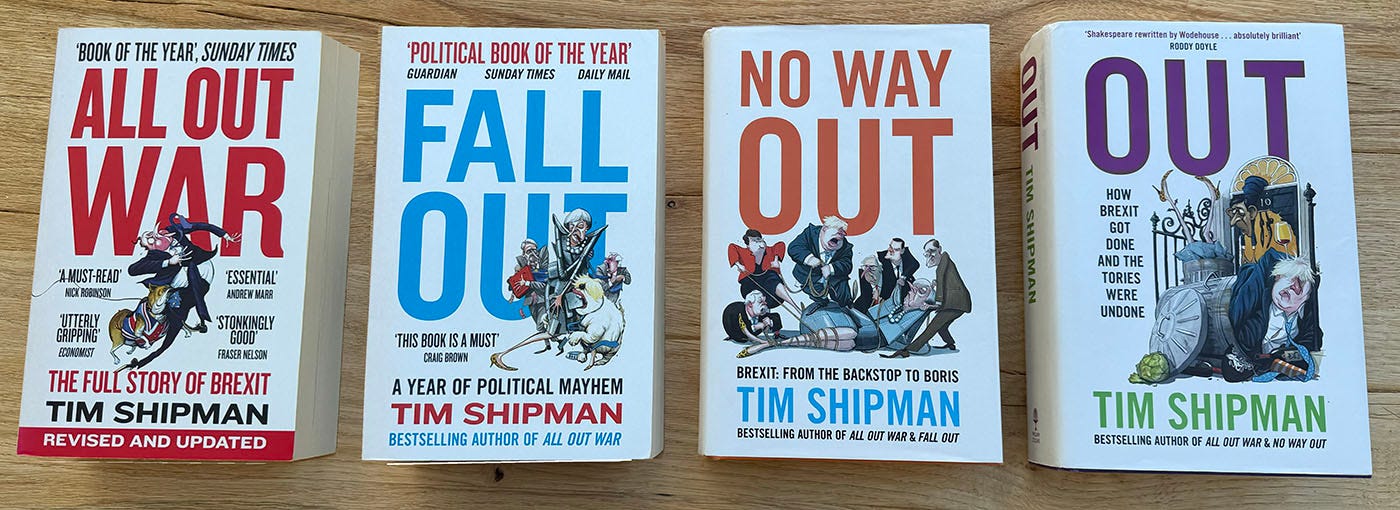
I at long last finished, “Out”, the last of Tim Shipman’s Brexit Quartet, (All Out War, Fall Out, No Way Out, and Out). Opinions on Shipman’s work vary, but as contemporary history goes it will remain4 the go to source for the events of the Brexit decade. Shipman is a typical Westminster hack and leans Tory (currently political editor of “The Spectator”), but Brexit is a Tory story and only a Tory leaning journalist would have the access to tell it as well as and as entertainingly as he does. He has the leading personalities nailed, especially the raging egos of Johnson and Cummings5. I laughed constantly, waking up Jane a few times too often (sorry), reading the Truss interlude section. He doesn’t entirely get Labour, but Labour was a sideshow and he also has the typical Westminster view the EU bubble, but it isn’t really their story either. At 2,994 pages the quartet is a bit of a beast and, unfortunately, the last two volumes lack an index, which is just crackers. Whatever the reasons for ditching the index, (most probably production costs) it unfortunately diminishes their usability as a reference work.
And a little bit of culture
Paul Thomas Anderson’s “One Battle After Another”, cleaned up during the film awards season and, I’d say deservedly so. At 160 minutes, it’s a long movie but moves along, is very watchable, Sean Penn and Chase Infiniti’s turns are stellar and the rest of the cast are pretty good too. Although it was conceived long before Trump 2.0, the final cut is very contemporary America. Treat yourself, it’s on Prime now.
If on the other hand you like your movies gothic and sumptuous Guillermo del Toro’s “Frankenstein” may be everything you could wish for. Visually gorgeous and a worthwhile retelling of a much told tale,6 it swept up the season’s design awards. I loved it. Incidentally, is 2026 the first year that both a Creature movie and a Vampire movie were both featured in Best Picture Oscar nominations? I’m pretty sure it is, in fact I think it’s the first time either form of movie has been nominated – which is bonkers, given the breadth of these sub-genres of horror.7
Of the other award nominated movies I’ve seen (I’ve not seen Sinners yet) I also very much liked “Bugonia” (Yorgos Lanthimos - The Favourite, Poor Things) didn’t win anything despite a quirky script and three fine slabs of acting from Emma Stone, Jesse Plemons and the tear inducing Aidan Delbis.
That’s all for me. Thanks for reading.
Till next time have a good holiday and take care.
John.
It’s amazing what you can do. Original pic - ruins of St Michael and All Angels' Church, Bedham, West Sussex. Simon Burchell, 2023. Creative Commons 4.0.
You can find the background to this in class free slagging fest in Jay Kuo’s The Status Kuo, 30 March 2026, here
“The hyper-remainer who led Labour MEPs. whose zeal was regarded as an impediment to compromise.” Tim Shipman, No Way Out, p 390.
geddit.
All very sweary.
I wondered how many Frankenstein flicks there were, the answer: since the first silent in 1910 is 481 movies have featured some version of Mary Shelley’s creature, around 20 of which claim to be based on her novel, loosely or otherwise.
I guess you could argue that both Poor Things (2023) and The Substance (2024) are loosely of the Creature sub-genre – but it’s a stretch.