A Million Lives
I read Alan Milburn’s report on Young People and Work so you don’t have to and, as you might expect, have some thoughts on what must be done.


Damning Evidence of Repeated Failure
The interim report on Young People and Work published a week ago is a serious indictment of UK public policy and government decision making.1 It’s findings should be tattooed inside the eyelids of every person in line to become a minister of any sort and many senior civil servants.2 This bit in particular, would do for starters:
“Public policy in the UK traditionally operates in cycles. A new intervention responds to rising unemployment or political urgency. It is funded for a defined period. It generates credible impact. Funding ends. Institutional memory dissipates. Responsibility returns to fragmented departments. The capacity is lost. Young people pay the price. It is, as one expert adviser to this review put it, completely mad that once a decade the state goes about building from scratch a new programme, with all the associated fixed costs of set up, capacity building, employer engagement, and data and accountability, only to let it expire and start again.”3
Prepared and written by the former Health Secretary, Alan Milburn, the report pulls few punches but avoids placing ‘blame’ on one cause or other, citing a combination of factors for the rise in the numbers of people aged 16-24 not in work, education or training but also identifying several accelerating trends. Overall, responsibility is laid at the door of a ‘system’ that, in so much as it is worth the name, has been left behind by economic and societal change.
What the report says
Overall, Milburn concludes that these systemic failures are failing a generation, costing the rest of us a fortune, and is rapidly becoming unsustainable. Those headline conclusions were widely reported, very much as “Report finds Gen Z are not a bunch of lazy Snowflakes after all”. The report is the diagnosis and the evidence – and there is a lot of that, “the weight is the point”, proposals for change will come later. The Behind the headlines Milburn supports his conclusions with a wide ranging enquiry which highlights:
Mental ill health is playing an increasing role in driving economic inactivity among the young.
Fewer entry level jobs are available, reflecting a shift in employment patterns hurting the young.
Fewer apprenticeship starts are available and the Apprenticeship Levy has proved a spectacular failure.
Education is no longer able to pick up the slack.
Not withstanding the contribution of qualifications to employability, those without work are better qualified than previously.
Those seeking to enter the world of work are less ‘work ready’.
The total cost to the country of the one million affected has risen to £125 billion per annum, which is apparently more than the education budget.
Loadsa Money
Now if you are thinking ‘£125 billion seems an awful lot’, you would be entirely right. Milburn’s figures go well beyond the immediate benefits bill and include lost tax revenues and economic potential. This is into the ‘opportunity cost’ field, but without such an assessment the very real cost to communities and our ability as a nation effectively to fund public services cannot be properly understood. But the ‘cash’ cost is damaging enough. The report highlights that for every £1 spent on getting this segment into work £25 spent keeping them on benefits. It is also worth stressing that Milburn is at pains to stress this is far from just a matter of fiscal peril, it is a crisis directly affecting lives and touching many more which is geographically and socially concentrated and which will inevitably get worse as ‘never had a job’ turns progressively into ‘will never have a job’.
Over almost 20 years since the financial crash irritated an underlying problem and even since the deindustrialisation of the 1980s programme after programme has been created, but we’ve now gone well beyond a bit of help with writing a CV.
What Milburn doesn’t do beyond a passing reference is talk about the job displacement potential of future technology roll outs. But this trend is affecting entry level jobs, or if you prefer, “lower value human capital”4 right now. On Monday morning Today5 interviewed, James Reed, CEO of the eponymous employment agency, who, in stating that the graduate job squeeze is real and current, pointed out that four years ago there were 180,000 graduate jobs on their website but last year there were 50,000. When Reed was asked what he thought graduates should do to better equip themselves for this changed market I found his advice less than convincing. Then on Wednesday evening Channel 4 News6 reported on research by The Work Foundation and the University of Lancaster which revealed similar figures for non-graduate employment. They found available entry level jobs had fallen from 139,000 to 70,000 over the past decade and further emphasised that this was a trend that developed well before blue could be laid at the door of either AI or Employer’s NI. These trends will push more into the ‘no experience no job - no job no experience’ Catch 22.
Change in Key Sectors
Meanwhile in retail, where I, everyone else in my family and many of my mates got our starts in the world of work, those Saturday and evening jobs just aren’t there in the same volume these days. Fewer staff working flexible contracts can extend hours and cover fewer stores which often process more internet returns than they make sales. You can’t shop online and expect underperforming stores to remain open. Retail was a great start – sales, cross sell/up sell, customer relations, presentation, stock organisation, generally remembering to turn up, doing what you were told7 and even solving a few problems – all good, nothing you learned at school. Retail was always the leading sector for young people’s first experience of work. Likewise there are fewer rolls in hospitality, food/drink too, the other sector that hired young people in numbers, which has never recovered fully from changes of habits during the pandemic.
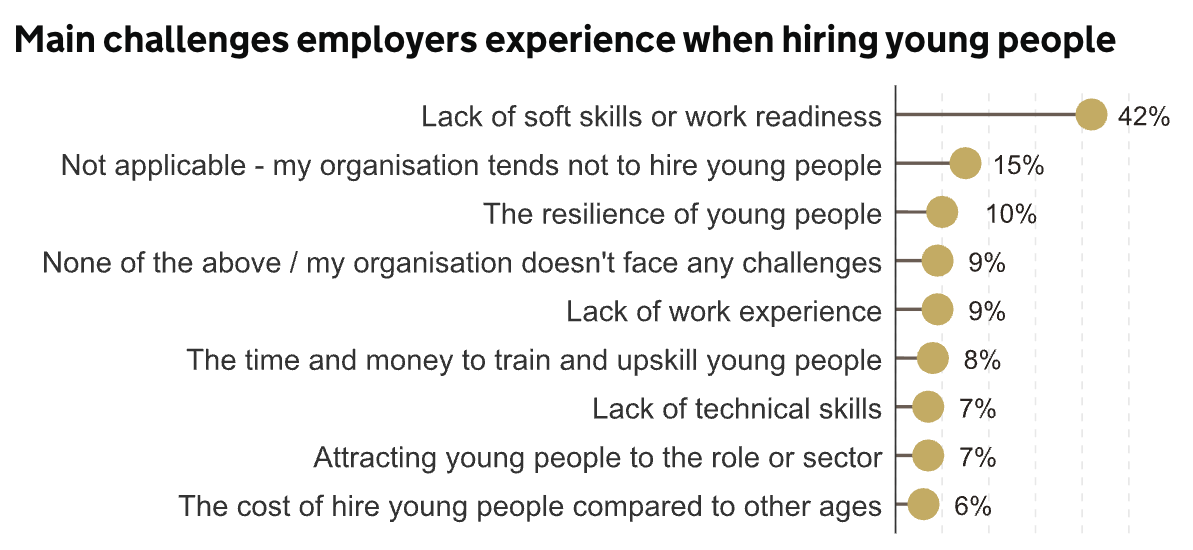
As an employer you wouldn’t put great score against Saturday jobs on a young person’s cv but it shows at least the candidate knows what work is. If somebody turned up for a role who had never even had a Saturday job I would think there was something wrong and would at least ask why not? (see chart from report below). But these days that approach is very much old hat. Applications are vetted by automation and computer says no. Assuming computer does let you through that process there is often a mutli-stage elimination process even for junior positions before you see a human.
So there are fewer jobs, getting them is harder and keeping one is fraught with difficulties.
Meanwhile in the NHS diagnosis and treatment is what it’s about but getting you back to work, or even acknowledging that you might have a job, seems completely beside the point. I have no idea what it’s like for young people, but the presumption at GPs and hospitals seems to be that people are available any time they suggest. The phrase “I’m at work at that time” is greeted with apparent bemusement.
Back in schools patterns are set early: arriving unfit to start school, special needs, suspensions, regular absences and ongoing disengagement all channelling toward a workless youth. The signs are many the correctives rare.
So in the end, why bother? It really is too much trouble and, though there might be ‘no hope around here’, there are no no go areas for benefits. It’s wrong to blame a ‘benefits culture’ for the woes of workless youth. Milburn cites plenty of evidence, quantitative and anecdotal, that young people want to work, would like a job to get a start in. Life, to establish a home a get some stability. But benefits bed in early and the income taper makes w rocking road out tough. I have written of the marginal benefit of work in this column and it remains true – people on benefits who opt to stay there are not morally reprehensible scroungers, they are rational economic actors who assess the value of work at its true marginal rate and act accordingly.
Milburn’s interim report is diagnosis without prescription, that is to come in the second part later in the year. But given the sweeping conclusions of a system unfit for purpose in both its key components and its overall architecture we can expect his recommendations to be sweeping. I’ve no doubt they will be sweeping but I’m less confident they will be politically possible. Milburn knows the difficulties in changing public services. He understands the resistance that can spring from other government departments driven by fiscal deadweight, rival politics, or both. He received notable ‘coaching’ in both of these realities of power from Gordon Brown. A set of recommendations that are entirely implausible or impossible to implement might as well never be made. It will be interesting to see if such pragmatism enters Milburn’s thinking, perhaps a road map to where we need to be and how such radical change can be made in our framework of governance would be useful exercises.
But here’s some brainstorm thinking on the necessary direction of travel:
Schools for life
Exam factories are all very well, but educating people is about a lot more than teaching children to pass arbitrary exams that are not much use to an employer and not almost no use in life. These ‘measures of knowledge’ exist as marks of academic progress and little more. Apart from managing survival and day-to-day in situ behaviour this is about the limit of what schools, as institutions, actually do. Individual teachers do a great deal more, but schools are not measured on any of that. We are not in the business of making citizens, we make academic candidates. If our schools were able to make young people ‘world ready’ that would go a long way to being ‘work ready’. Ultimately, this lack of apparent relevance is behind a great deal of disengagement.
Breaking this will require a massive change of approach and I doubt that Milburn will go that far, but a start would be seeking to address this question: if the signs of a workless future are apparent early what, then is the plan for early intervention? We long since abandoned wholesale academic selection/rejection at 11+, but if it is self evident that a particular route is not likely to work what is the plan other than doing the same things and expecting different outcomes? There is a very simple, uncomfortable fact here – people who fail academically don’t make a school look good or rate well – so abandon them, pull up the middle and let the top succeed.
Neither do I expect Milburn to address another uncomfortable reality. I have watched over my lifetime a move from jobs and trades for life to working lives where change is the only constant. Learning new skills will be necessary throughout life. While the thought of never entirely ‘leaving’ school would have horrified me, I would have ben wholly comfortable with the idea of always having one foot in education. At some stage we need to grasp that re-inventing re-start programmes is just bonkers and recognise the need to return to education and training as a matter of routine.
Sick Again
One of the things we should want our education system to deliver is a citizenry who are able to understand their own physical health and make informed decisions about it. Statistics I have quoted in this column previously show how badly we are failing. If this is not the job of schools then how do we propose it will happen? But there are two big trends that contribute to young wordlessness that would not be addressed through broader knowledge of personal health. One is the increased diagnosis of special needs conditions, in particular autistic spectrum disorders, and depression/anxiety issues. Again as I have said before here, the former is at least in part down to greater understanding and awareness of the conditions. The conditions that amount to mental ill health have rocketed and again, I suspect in part because they are taken more seriously, but they are also seriously costing the country and the affected individuals. It is easy to seek a reason for all this, but there is also a clear reality: social isolation and a world where contact with others is harder and harder – so what is the plan? what does prevention look like? Or are we all to busy doing TikTok? I’m not sure the NHS is capable of addressing these issues as things stand. It’s reality is still a massively compartmentalised treatment silos that are anything but holistic. Milburn was an innovative and effective health secretary who, following on from Frank Dobson, got waiting lists down and treatment outcomes going in the right direction but I expect he knows that the entire architecture of the service leans against an effective approach to mental ill health.
Work that pays
Incentives to working are essential. It’s an old chestnut to cite the contradiction between incentives and rewards for high-performing (or even bang average) business bosses, yet to get those on benefits to work you need sanctions. The microeconomic reality of my ‘marginal benefit’ approach cannot be denied, so those making the decision to go to work have to see the gain. Only that way will be get them off the benefits bill. Tapers into earning need to be shallow. At present benefit is lost at a rate which means the state recoups more of each pound earned than the worker keeps. This doesn’t work. Further than that, work is a bind, it can be boring, so there has to be a reason to stay – what about bonuses. Make 12 months in work and you get £1,000. Make two years and you get another £2,000, some kind of claw-back system, – set that against the fortune it’s costing in benefits. This isn’t thought out at all, but Milburn needs to come up with at least the bones of a plan that is different to what’s been tried before because what’s been tried before has a failed. I could also go on a lot about where the public sector could create experiences of work and how a ‘public youth service’8 element could be added to the offering for of young people to ensure projects and experiences outside the context of school, but I have neither the time nor the space right now – but think on it.
Waiting for the next bit
I don’t underestimate how difficult this exercise will be. As for how all this fits together as a ‘system’ with a chance of working – i.e. preventing young people falling into workless futures and turning round the upward trend – good luck with that. We will know when we know if any of this is successful, but I expect we will know a lot sooner if it is possible. The response to the next stage of Milburn’s report will also tell us about the determination of our politics to address the need for and nature of work more broadly before we find ourselves in a technology induced crisis.
As an endnote, this. Throughout my political life I championed jobs and work in one way or other and insisted that it was always part of our local government agenda. It comes from my background in which the fear of unemployment was very real. When I was working on the EU Budget I put a lot of time and a fair bit of hot air into maintaining the investment into youth employment programmes. The UK lost those funds with Brexit and, surprise surprise, the promised increases in UK funding to replace the loss never came good. Spain, Italy, Portugal continue to benefit from funded programmes. I saw some of the programmes in the UK and they weren’t bad, but how effective they were long term I can’t say. In the later stages of the mandate I found a weariness creeping into the debate – youth unemployment wasn’t really a thing anymore, jobs were different now, it’s all online. This struck me then as detached from reality. It still does.
Shiny Football Things in North America
Today we are a week away from the start of the F*** World Cup. 104 football matches which I dare say will seem endless, especially if football isn’t your bag and I fear for many of us for whom it is.
The best I can say is that it will fill a lot of the already stark gap until club football returns. The last World Cup in unlikely Qatar was an on field success, with a final for the ages lit up by the best footballer in the World as it should be. Lionel Messi having completed his set and being four years older, I’m not sure who that is right now. My unfortunate feeling is France may lift the trophy, maybe in a final with Spain, though I’ve not looked at the draw. The Portugal side is very talented, though small countries don’t win the World Cup, and the courage required to pension off Cristiano Ronaldo did not materialise. I think England will find the conditions too much and in any case I look at the squad and I do not see the level of talent. If they make the quarter finals they will have done well.
However quality has been diluted, some of the early games are unappealing. What we will see is a range of changes that will affect club football. Whatever the thinly disguised BBC campaign to undermine VAR might say, F*** say we are to have more VAR not less, so says Pierre Luigi Nosferef,9 and that will follow through whatever Gary Lineker and Alan Shearer think.
I will write something more meaningful next week. Or the week after.
That’s all for now. Thanks for reading.
Till next time take care
John.
The report is about Young Peope Not in Education, Employment or Training. I get through this whole article without using the term NEET. I like a challenge, me.
A friend suggested this would require a very small font. Maybe `instead their eyes could be kept open while it played on a constant loop, Clockwork Orange style.
Young People and Work: Interim Report. Alan Milburn, DWP 28 May 2026. Para 671
Nice. Bill Winters, CEO Standard Chartered, a Bank, quoted just about everywhere.
BBC Radio 4. Today. 1 June 2026. 06:50 BST.
Channel 4 News. 3 June 2026, 19:00 - item at 19:45 BST.
I wasn’t so good at that bit.
I don’t say ‘National Service’, because that has connotations of conscription and it isn’t what we need, nor what the forces need or want. So the term is polluted.
Or Collina aas he prefers to be called.